General Posts


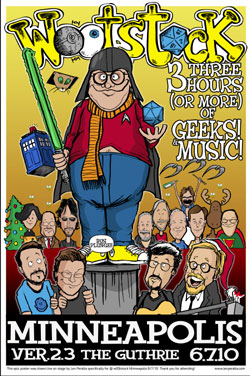
John Scalzi is an awfully good science fiction writer. He’s also no slouch as a live performer. When the boys from of Wootstock (Paul and Storm, Wil Wheaton, and Adam Savage) put together their show for Minneapolis in June of last year, they invited him as one of their guests.

 
NeeeeeeeeeeeeeeeeeeRDS!

Luckily, they also release their show under a creative commons license, so fan vidoes of every Wootstock performance can be found on the internet. The Minneapolis show had particularly good recording made (thanks grnbrgb). Other segments from the particular show will probably show up in the slush pile again.

Here’s John Scalzi reading his short story, “Morning Announcements at the Lucas Interspecies School for Troubled Youth.”


(via Whatever)

The Internet is a giant slush pile, and I’m the unpaid intern wading through it. Here’s a bit of pretty dredged from the dreck.

I downloaded Champions Online a couple of weeks ago when it went free to play. Tried to get into it last week but got bored with the character creator. Not the stat building, because I chose my class pretty much at random. No, I got bored trying to figure out what my character would look like. 

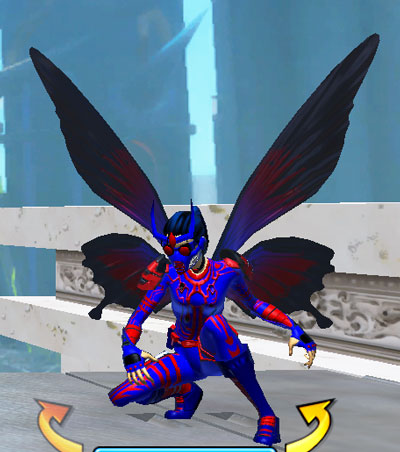
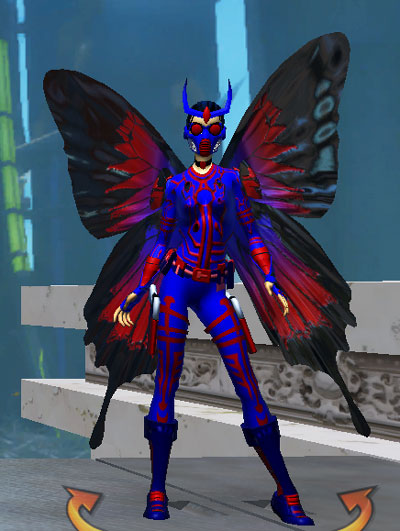
I took another run at it last night, using Epiphany as my starting point since she’s one of my few superheroes whose costumes I know what they should look like. They didn’t have labcoats, so it ended up not being Epiphany. However, they did have some wicked looking butterfly wings, eventually giving us FLUTTERDIE:


Origin: Long story. Let’s just say that alien sorcerers are strange.


This is the default stance for female characters. I switched to the action pose.

I needed a vigilante type in Monday’s Dictator memo, so I think I’ll use my new hero there.

I bought a new iPhone. Verizon finally manage to snag it for their network, and the power supply for my Blackberry has been more twitchy than usual lately.

I’ve already intergrated it with my iTunes stuff and my email. Anyone have suggestions for additional junk I should buy for it or apps that I should download?

An interesting conversation took place in the comic book world over the past week. It started when Eric Powell, creator of the award winning comic The Goon, posted a video criticizing the lack of genre diversity in comics. I’d post it here, but he’s since taken it down, presumably because either because it wasn’t particularly well argued or because it wasn’t particularly well presented. Jill Pantozzi has a summation of the video here, as well as her own thoughts on it. Here are some commentaries on it: Scott McCloud, Van Jensen, and Tom Spurgeon. There were also conversations comic news/commentary sites: one on Comic Alliance, and several on The Beat.

I’m less interested in examining the video itself (I think it wasn’t well argued or presented, myself). However, I did post my thoughts about the follow up conversations on The Beat, and I’m cross-posting them here.

1: In which I discuss the emerging digital download market which the video completely ignored as a commercial outlet and the realities of making a living off your art

I expect the growth in the digital download market will spur growth for drama comics, simply because drama is more satisfying in larger chunks; there’s a reason sitcoms are thirty minutes and television dramas are an hour, after all. Comedy has the edge in webcomics, just like it does on the newspaper comics page. Drama comics can get by on the web (Family Man, YU+ME: dream, Sailor Twain, World of Hurt, Zahra’s Paradise), but the daily joke rules that side of the business.

Digital downloads have enough format differences from floppies, trades, and webcomics to make them the preferred format for an under-exploited audience. Since that audience will expect them to come out on a floppy or trade time-period, expect drama to dominate the format just like it does in the direct market. As there’s no shelf space limit like there is in the direct market, expect the independent stuff to dwarf the Big 2, Archie, and Disney. The tech to create and deliver the work just doesn’t require a big corporate middle man to hold the bag. The only advantage a big corporate middle man might have is in building a big enough digital storefront for costumers to randomly browse through. Even then, any creator that doesn’t also sell his digital downloads off his own website to cut the middleman out of selling to the creator’s hardcore fanbase is an idiot.

Will digital downloads be enough by themselves? Probably not, but comics by themselves never were. Newspaper comics, webcomics, and comic books have ads. All three have trades that repackage the content in books that doesn’t have ads. All three merchandise (suction cup Garfield for your window, Fat Pony T-shirts, and Wolverine action figures). All three license to the other, bigger, riskier, more profitable mass mediums (Peanut holiday specials, Batman movies, Penny Arcade video games) which is where you actually hit the lottery with your work. Sure, Harry Potter level success in books will you a millionaire, but Harry Potter movies and merchandising is what it takes to make you the second richest woman in England.

The marketing for most direct market comics, even from the Big 2, is bad. The profits margins aren’t there for something much better than what a one person creator can manage in the internet age. A determined and patient creator can create more marketing for himself now than ever before. It won’t be overnight. In fact, usually takes years, but we are talking about creators who intend to do this for their entire life, right?

While you’re struggling, keep your day job. If you’re already in the direct market, there’s no reason why shouldn’t stay in it while you build up your own creator owned works that you can sell again and again and again, year after year, as floppies and trades and webcomics and digital downloads.

I keep running into these unrealistic expectations that finding more audience in a new format should happen instantaneously, instead of being the backbreaking work making your living off your art always is. Is it the fact that artists have an actually, marketable skill out of college that is useful in the business world that skews these conversations on these direct market specialization sites? The awards for best new novelists usually go to people in their THIRTIES. Actors are disgustingly hit and miss in their cash flow, no matter how successful they might have been in the past. Sniveling in public that you might have to lower yourself to get a paycheck to keep pursuing your preferred projects is really annoying to some of us coming from those backgrounds. Making money from doing something creative is tough, and building a new business from scratch takes time and effort. Just be glad that it’s easier now than when Jeff Smith and Dave Sim started theirs – or when Scott Kurtz and Fred Gallagher started theirs. (Fun fact – Fred Gallagher? His webcomic Megotokyo is the only one whose trades are published by DC or Marvel, and his last volume came out under the DC Comics imprint itself. And it’s a drama webcomic. It was the only title to survive DC killing the CMX line. Know why it survived? Because the trades were too profitable for DC to just drop it. The collections of a comic you can read on the internet for free were too profitable for one of the Big 2 to let go. The future is now, kids.)

Oh, and only 300 million people? If you’re only aiming for America when talking about delivering content on the internet, you’re aiming too small.

2: In which I discuss the recent markets for mass media and how they impact comics

If we’re going to talk the history of money in comics, we have to include the fact that comics are a mass medium and competing with every other mass media for the time and money of a limited audience (6 billion+ people big but still finite). In the direct market era, we’ve had two new mass media mature, video games (now the same size as the movie industry) and the internet (hi there!). I’m not going pretend I have the numbers at my fingertips, but I’m guessing there’s a strong correlation between the rise of those industries and the decline in direct market sales. There has certainly been one reported between their rise and the subsequent decline of television. Video games just steal time and money, which makes it tougher for those in the older media. The internet has been something else.

Like video games, internet has been another time and money sink for consumers. However, it has also opened up new distribution channels for content sellers, like people making comics. We’ve seen the webcomics side of the industry grow from strips put up for fun to having a solid cadre of full time professionals. Here’s the Wikipedia list  for those that missed it on the other thread. Add in the many, many semi-pros on the net, some of whom will eventually be pros, and we start reaching numbers matching the number of comic creators in the newspapers.

I know there are some that like to claim that making it on the web is like hitting the lottery in terms of the odds. They’re absolutely right. However, the odds making a living doing comics in newspapers (Peanuts or Garfield), magazines (Mad Magazine or New Yorker), or the direct market (Batman or Cerebus) are every bit as bad. If you’re making your living doing comics, it’s because you worked hard enough to get enough lottery tickets to have a real chance of earning a living wage. Maybe you wrote regularly to the comic’s letter page. Maybe you carried your portfolio to cons year after year. Maybe you had an internship at one of the publishers’ offices. Maybe you got a lot of rejection letters. However you did it, it was no less work that the process of assembling an audience one by one on the web. Yes, there is an element of luck involved, but work can do a great deal to shrink those odds to something manageable, assuming you have the talent to create something worth the audience’s time.

Now digital downloads are adding another distribution channel for comics, and it’s in a format that should work well for the same types of creators that enjoy working in the direct market. Heck, it should even carry the Big 2 as the direct market and book stores continue to contract.

Contract, not disappear. If hardbacks, trade paperbacks, and mass market paperbacks for novels can exist side by side for decades despite being the exact same product in only slightly different packaging, then that suggests packaging as different as floppies and trades and webcomics and digital downloads will all have audiences that will support them.

Collectors and floppy fetishists will keep that format going, but it will be increasingly dominated by older titles and titles tested first as mini-series by the Big 2 in the digital market that are then relaunched with a first issue to catch the direct market’s attention. Independent creators will abandon the direct market for digital downloads, unless they are floppy fetishists themselves.

To extent they work with the direct market, independents will ship trades collecting their digital work. The webcomic guys already do. Oh, some are ignoring it and selling their trades just by their websites and at cons, but some are paying the price of splitting money with a publisher to get into the direct market and book store distribution channels. Turning my head, I can see five different webcomic books on my shelf with Dark Horse on the spine, one from IDW, and one from Archaia. Digital downloads are nice, but they’re hit and miss as gifts and you can’t read them in the tub.

The relationship between digital downloads and webcomics will depend on the content. If it is drama, the webcomic side will probably be only modestly profitably but will drive consumers to buy downloads they can read comfortably away from their clunky PCs. If it is comedy, downloads will be driven by those that want to own the files for the strips or want to reread them comfortably away from the internet or their PCs. 

That ownership is pretty important, since there’s no guarantee that the website for the comic will be up forever.  Cloud storage has its place in computing, but it doesn’t actually replace having a file on hardware in your own possession. DRM on the downloads has a similar problem when the specifics of the format encryption becomes unsupported because of business failures and software changes. However, at least if you have the file in your possession, someone on the internet will eventually figure out how to jailbreak it.

Or, if you’re like me, you’ll just wait the publishers out like I did the music industry. Dear publishers: I don’t care if your business fails – I won’t buy from you if you have DRM. Yours won’t be the first creative endeavor to abruptly stop, and I got plenty of independent creators to fill the void you left behind.

Okay, that’s the best I can do for where we’ve been and where I think we’re going without writing an entire book. I just get wound up by those who think their little sliver of the market is the whole business of art and commerce, and then compound their error by seeming to be oblivious to the fact that their little sliver used to be different in the past.

In response to a post on The Next Best Book Blog where they were lamenting the fact that most states have dropped cursive from the elementary curriculum, I wrote the response that followed. My third response was completely ridiculous in length, so I posted it only here. Head over there if you want the full back and forth.

First Response:

Well, cursive is designed for writing large chunks of text quickly, and no one does that anymore in business world or the academic world or the art world. Speaking as someone who stopped writing in cursive while in high school not quite two decades ago, I can’t see any practical reason to keep teaching it.

Second Response:

As with any other out of date and unused chunks of human knowledge, a group of amateur and academic specialists will emerge as curators of its history. Think of Egyptian hieroglyphics or the Greek alphabet to keep in same vein as cursive. As a society, we can still read them. If person wants to learn it or just get something translated, there are others who maintain that information – or even recover it. We can read Mayan hieroglyphs today, which is not something we could do a century ago. Sure, my grandkids might not be able to read my parents’ love letters without going to see an expert, but like many Americans, I couldn’t read my great-grandparents’ love letters because they’re weren’t in English. But I could find someone who can; specialists are wonderful people.

Dropping something that isn’t useful to the current world and not unique in ways it teaches a person to think is neither unreasonable nor unprecedented. Within my parents’ lifetime, Latin went from taught in every school to being taught in almost none. It wasn’t useful enough anymore. It went from the language of an empire to a language of the scholars to a language of just the scientists. Once it was supplanted in science by German and later by English, it was just a matter of time before it fell out of our curriculum. Sure, it was useful for learning any of the Romance languages, but you know what also makes learning those languages easier? Learning any one of the Romance languages. They’re not any further apart from each other than they are from Latin.

If cursive taught the kids something unique, I’d demand they’d keep it in school. But I know the kids are getting a second language in school earlier than I did. I also know they’ll be on their computers, running into Arabic and Japanese and Chinese scripts as they bum around on the internet. They’ll be changing fonts to Comic Sans for really inappropriate works with their word processors. They’ll understand that how language is presented can be more than upper and lower case.

So, yeah, I’m okay with saying goodbye to cursive. It frees up time to teach the kids something else about language.

Third Response:

Is cursive intrinsic to learning English in all its forms? I argue that it is not. We don’t use Old English anymore. We don’t use Middle English anymore. We don’t use the letter thorn. We don’t use English in all its forms. Why should we teach the parts that aren’t used or useful anymore to our kids?

Handwriting is not just cursive. It is both print and cursive. They are not dropping teaching printing, only cursive. TBBNC Super Mod, in your second response, I’m unclear if you think they are dropping both from the curriculum or that other circumstances will cause humanity how to forget how to write in print once the bomb drops. Really, after the apocalypse, the knowledge of how to handwrite long notes quickly instead of slowly is not the worst thing the average modern human will be missing from their knowledge base.

Cursive is just a specialized font for writing many words quickly. My concern about it becoming unreadable is that as a font, it distorts some letters to the point where there is only a passing resemblance between the print letter and the cursive one. It is not as bad as the differences between hiragana and katakana in Japanese, but it is a noticeable one. If cursive is not taught, I do believe that later generations will not be able to read earlier cursive without a specialist’s assistance. It is a loss, but not one I consider good enough to continue teaching it.

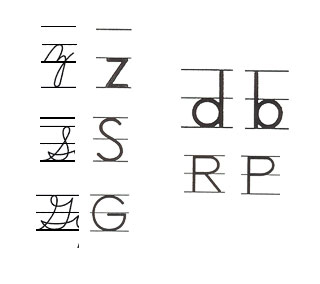
Some these things don't look like the others

I’m just saying the sets on the left look less like they go together than the ones on the right


We teach Roman Numerals to our kids. It’s not directly useful anymore, but I suspect it hangs around because it establishes early that the Arabic numbers we teach them first are not the only way to handle numbers. It’s a very useful bit to know when it comes time to learn binary or hexadecimal numbering systems, if their math education requires them to go that far. I’m not a math education specialist however, so my reasoning could be wrong.

The parallel between print/cursive and Arabic/Roman numerals would be the lesson that the print letters are not the only way to handle written language. My points about foreign languages and fonts were addressing this parallel. I believe that exposure to foreign languages and easy font changes will convey that lesson without also teaching them cursive. I apologize that I didn’t clarify that point.

The only lessons cursive teaches are how to handwrite quickly and the notion that the first language they teach is us not the only way to handle language. If there is any additional specific reasons to teach it that I do not have an objection to, I don’t see them here.

The reason that writing notes during lectures gives better results than typing sound reasonable enough that I will concede that point without asking for scientific proof. However, it does not address any differences between taking notes with print or cursive. Having survived middle school, high school, and college with just print, I’m afraid I will require scientific proof on the possibility that cursive is better than print for learning during note taking. However, I will not be offended anyone finds my anecdote insufficient to prove print is just as good cursive to note taking, as anecdotes are a lousy way to prove a sweeping statement about how people learn.

Actually, anecdotes are a lousy way to prove any sweeping statement. For example, writers who find handwriting assists their creativity are nice (Neil Gaiman is one award-winning author who prefers to work that way), but they don’t speak for all writers. For example, my first graphic novel script and my first novel were both handwritten and then typed up. Everything after has been directly into the computer. I haven’t noticed a drop in my creativity. It also doesn’t seem to be holding back authors who just use computers (John Scalzi is one award-winning author who prefers to work that way so much that he became award-winning without even owning a printer to make a hardcopy later.)

Yes, cursive is pretty when done right, but we have art and music to teach the kids pretty. (If you want get the knives out to go after those cutting art and music from curriculums, my blade is yours.) When cursive isn’t done right, it’s too often an illegible scrawl. I had both science professors and English professors express appreciation for the fact that I printed when I handwrote, since they knew they’d be able to read it. I wouldn’t draw too much of a conclusion from that, except that it suggests that cursive was already declining in use then and that some human beings have really atrocious cursive. We already knew the second, or there wouldn’t be all those jokes about the bad handwriting of medical doctors.

There is no legal requirement that signatures be in cursive. I’m curious to see what the younger generation comes up with for them. After I dropped cursive myself, I changed my signature to an illegible scrawl that vaguely resembles the cursive script I was using before. Which meant my signature was now in the same illegible scrawl style that all the adults I knew used. In any event, I’m sure whatever the non-cursive taught kids come up with, it will annoy the hell out of the older people who will then moan about how bad the younger generation is, thus fulfilling the ancient prophecy and putting off the Apocalypse for yet another generation.

The objection that they’re cutting cursive without replacing it with something useful is just silly. Oh, I’d be happier if the replacement was of the teaching-how-to-think-critically variety, but it is not like cursive was great at that, since it’s mostly memorization, repetition, and practicing motor-skills. Let’s not pretend the secrets of the universe were hiding within its unbroken lines. Unless they were. In that case, we truly face a future of post-apocalyptic slowly written notes.

The boys at Webcomics Weekly, a podcast for webcomic professionals, talked about digital downloads for comics this week. They had to cut their show short this week and asked for input from the audience. It’s a subject I’ve given quite of bit of thought to, so what follows it what I wrote to them.

Dear Dave, Brad, Scott, and Kris,

You guys asked for thoughts about digital downloads, so I’m writing you. I’ll put the most important part first: your readers have no guarantee that your web offerings will be available tomorrow. You could go broke tomorrow or you could get run over by a beer truck without leaving any heirs. Soon enough your work disappears from the web, except for what remains in various archives which are harder to find and ultimately suffer from the same weakness. I know I archived my defunct webcomic Phantast Staffing Services at my personal website patrickrennie.com, but if you linked to phantaststaffing.com back in 2005, that site it gone. I’m part of the audience that rereads things I like. Let me buy a digital download so I can have a copy in case you disappear. Or just one I can reread offline when I’m in an area where internet coverage sucks.

But I can already do that with your books, right? Right! To drag Kirkman into discussion, I can read his works as floppies, as trades, as Ultimate hardcovers, as Complete Library hardcovers, as an iPhone app, and as a comiXology download. Yes, there are overlaps in terms of audience, but the existence of one format does not mean another cannot be profitable. That, or Kirkman and his artists are losing a LOT of money.

The question is what digital downloads can offer that the other format don’t. Let’s start with webcomics: no ads, quicker rate of page turning in areas where the internet isn’t amazing, no bandwidth usage, no internet failures to worry about. Depending on the habits of the reader, there is another: the assumption that the download will be the only thing you are doing for a while, just like using your tablet for playing a video game or reading a book. If you’re reading webcomics, the odds are pretty good that you’ve got another tab open or you’re going to follow an interesting looking link in the notes to something else on the internet. That’s not a huge problem for daily comedy strips like yours, but what about the drama webcomics? Remember, different formats have different (if overlapping) audiences. Drama reads a heck of lot better in large chunks, which is why comedy dominated newspapers and drama dominated comic books. Dylan Meconis should probably have a download for Family Man and Bite Me! Jonathan Rosenberg should definitely have some for Goats, since the material already exists and he couldn’t make it profitable with just the web and books.

So the drama comics should absolutely do digital downloads, even if they’re like comiXology’s currently neutered style of downloads. The comedy strips like yours should consider if the time spent repackaging will pay off in enough additional revenue for the content. That’s especially important if you’ll just end up doing it again in ten years after the digital download market settles on a non-DRM standard like the music industry did, and you have to replace the clunky DRM versions with something more consumer friendly. Still, to get into a marketplace of digital download readers who only partially overlap with webcomic readers, it might be worth it. Sure, the middlemen take a piece of the action, but they also collect a lot of money-spending consumers in one space – sort of like the people who run comic conventions. You pay for your table, but you also gain access to a slightly different audience than just what your website brings to you.

Okay, back to downloads versus other formats. Let’s lump all the magazine and book types together. Magazines and books offer better resolution in a less eyestraining format, flexibility in size without a fixed screen size to fit into, don’t require access to electricity to read, and never suffer crashes. However, they take up shelf space, bend, rip, get moldy, and burn well. Phone downloads have a really small screen size that often require reworking the material to make it readable, sometimes in ways that really change how the material flows for a reader. Direct brain projection offers the crispest visual experience, but they still haven’t figured out to consistently prevent “traumatic afterimage episodes,” which are widely blamed for the increase in automobile accidents among projection users. And, of course, cave drawings are really hard for the consumer to carry around.

So, what should downloads feature? Ideally, no DRM. Ownership is a big selling point over just reading it on the web. By the same logic, the image quality should be high enough that a professional quality printout should be possible from the file, again for the creator-suddenly-drops-dead scenario. Yes, there are some new piracy risks that someone might make unlicensed hardcopies – for something the audience can read free on the web and probably buy cheaper in hardcopy directly from the creator. After that, a creator might want additional content for digital downloads of the sort that usually gets added to hard copies: behind-the-scenes-making-of material, original content, and/or commentary. A phone formatted version bundled with the regular version would also be a good idea. Video games, wallpapers, or other original electronic files should probably not be part of the download to help the market develop a standard format for digital downloads. However, bundling a unique code like the video game market currently does allowing access to such things might be workable, assuming the creator is willing to go through that much work. Heck, Sam Logan of Sam & Fuzzy did something like that so his book-buyers could download wallpapers, and he can’t even set up a RSS feed for his comic. It’s called Comicpress, Sam! Get with the times! I’ll click through to the main page as long as the feed reminds me that there’s something to look at, dammit, just don’t make me rely on this crappy memory of mine!

What was I talking about? Downloads, right. Okay, reading back through, it looks like I covered everything I can think of for the moment. Well, shameless plug here at the bottom then: if you know any artists looking for a writer, send them in my direction. I’m actively looking to produce things in public again, and I folded up Phantast because I draw slowly and poorly, not because I was having issues with the writing.

Keep up all your good work, gentlemen.

I’ve been without a favorite album for a while. There are certainly albums that I like, but they all contain some tracks that are duds.

I used to have one that I loved from beginning to end: Counting Crows’ “August and Everything After.” Listening to it a few years back, I realized the singer is not romantic so much as a complete douchebag. I may have grown up a little since I fell in love with it.

Anyway, I was working third shift the other week, and this song came on our college radio station. I glad to say I haven’t grown up all that much: I enjoyed the use of swearing in the chorus. Here’s the video. NSFW for language.


So I bought the album “Sigh No More” from Mumford & Sons, and I like every track. I may have new favorite album.

I’m updating my links to bring my recommended reads up to date. I’ll finish it up in the morning, but I noticed that I haven’t quite covered the entire alphabet with the webcomics. I still need to find comics for E, I, N, U, and V. U and V I can sort of understand, but the other three have me baffled. I really haven’t run across anything yet for E, I, or N that I love? I mean, I have X, Y, and Z covered. I even have two for Q. How strange.

« Previous PageNext Page »